
User Manual: Vvolt UL-2271 Type Batteries (RANGER Battery)Updated 14 days ago
User Manual: Vvolt UL-2271 Type Batteries
Notice: Vvolt UL-2271 "Ranger" batteries require periodic charging during storage. If you don't ride regularly, check the battery at least every 60 days and charge it for 30-60 minutes if needed. Do not store a battery deeply discharged or fully charged for extended periods. For storage longer than a few weeks, charge to approximately 30-50% (2-3 bars on display). The best solution is to ride your Vvolt frequently.
Your Vvolt is powered by a lithium-ion (Li-ion) battery. Always follow these instructions for handling, charging, storage, and riding. Use the Vvolt battery only with the corresponding Vvolt vehicle. Do not use a Vvolt battery with other products or any other battery with the Vvolt bike, even if it fits.
These batteries have been sold as OEM equipment in Alpha II and Centauri II e-bikes beginning in March 2024. They are also available as retrofits for previously produced Vvolt e-bikes.
These batteries are solely intended for use on Vvolt e-bikes. Using them in any other make or model will void the warranty on both the battery and vehicle and can cause product failure, resulting in inoperability, electrical arcing, or fire.
Charge the battery only with a Vvolt-branded or Vvolt-approved UL-listed charger specified for this battery. Use of a non-approved charger will void the battery and charger warranty and can cause product failure, resulting in inoperability, electrical arcing, or fire.
Ranger batteries are available in two versions. Some instructions below differ depending on whether your battery has a silver power button.
IDENTIFYING YOUR RANGER BATTERY
Vvolt Ranger batteries come in two versions. Before following the operating and charging instructions below, identify which version you have.
Original Ranger Battery
Does not have a silver power button.
You cannot manually turn the battery on or off.
The 3-pin charging port is located at the bottom of the battery, directly above the main battery terminals.
This version was supplied on Alpha II and Centauri II e-bikes and may also be installed as a replacement or retrofit on compatible Vvolt models.
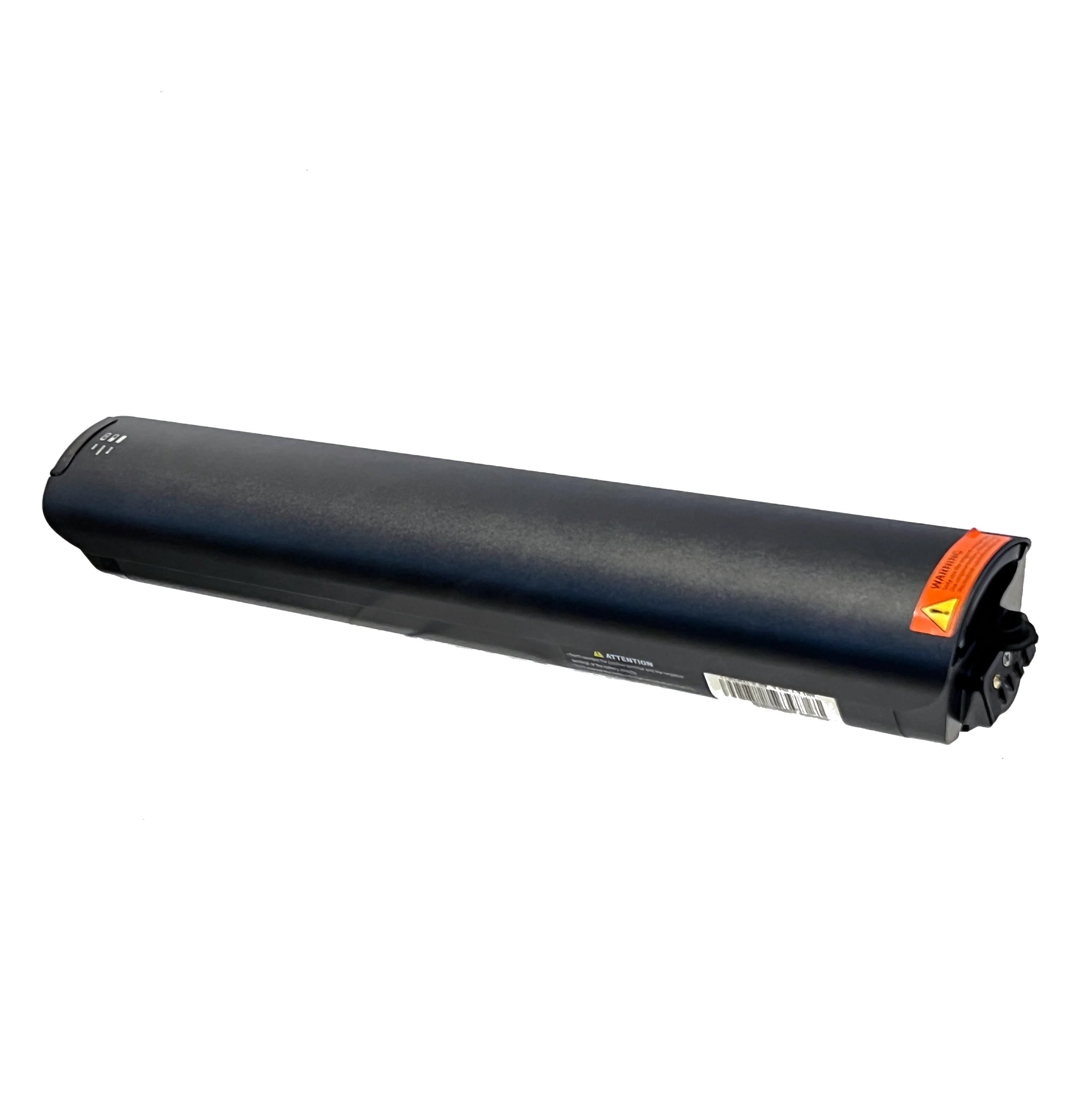 Original Ranger Battery: no silver power button.
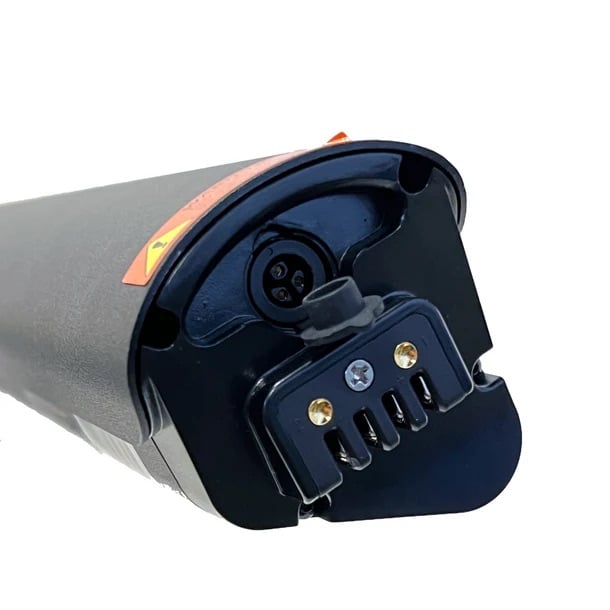
The Original Ranger Battery charging port is located directly above the main battery terminals.
- Newer Ranger Battery
The battery has a silver power button near the bottom.
The power button turns the battery on or off.
The 3-pin charging port is on the side opposite the silver power button, not above the main battery terminals.
This version was first supplied on the Alpha 2.1
 Ranger Battery with Power Button: the silver button allows the battery to be energized or de-energized.
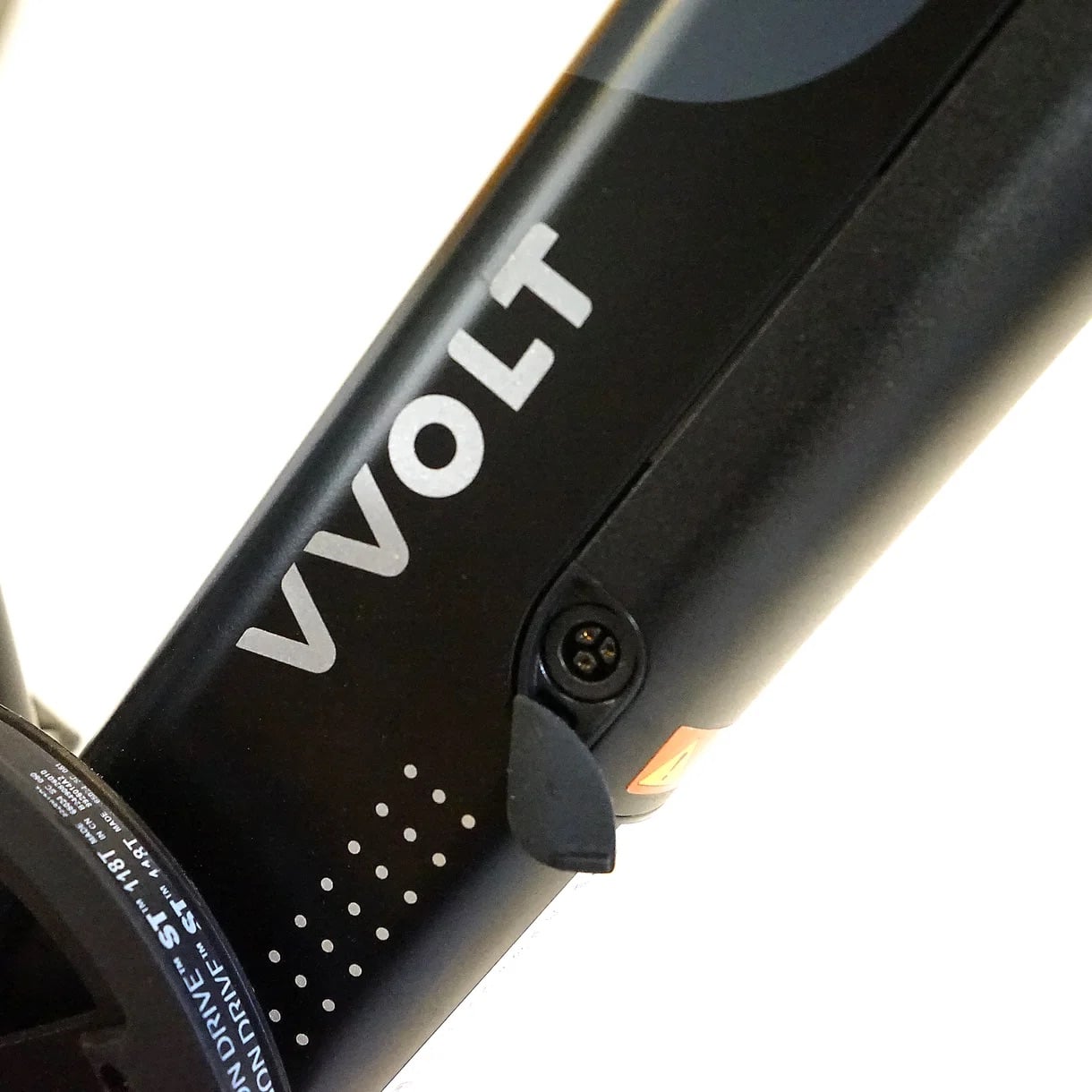 The charging port is located on the opposite side of the battery from the silver power button.Quick identification: If your battery has a silver power button, you have the Ranger Battery with Power Button. If there is no silver power button, you have the Original Ranger Battery.
INITIAL BATTERY USE
Notice: Fully charge new batteries before their first ride. The battery is fully charged when the Vvolt charger indicator changes from red to green. After your first ride, recharge the battery as needed. Do not intentionally discharge the battery completely before recharging.
INSTRUCTIONS FOR USE
Original Ranger Battery
Press the clear LED status button to see the remaining battery capacity.
This battery has no manual power switch and does not need to be manually energized before riding.
The charging port is located at the bottom of the battery directly above the main battery terminals.
Ranger Battery with Power Button
The silver power button is located near the bottom of the battery.
Press the silver power button to energize or de-energize the battery.
When energized, the button is pushed in.
When de-energized, the button sits flush.
The clear LED status button is located near the top of the battery.
Press the clear LED status button while the battery is energized to see the remaining capacity.
The status button only functions when the battery is energized.
De-energize the battery before installing it on or removing it from the e-bike.
De-energize the battery before charging.
Energize the battery before turning on the e-bike.
The charging port is near the bottom of the battery, on the side opposite the silver power button.
How, when, and where to charge your Vvolt battery
First, identify your battery's charging port:
Original Ranger Battery: The 3-pin charging port is located directly above the main battery terminals.
Ranger Battery with Power Button: The 3-pin charging port is on the side opposite the silver power button.
Plug the 3-pin charger terminal into the port on your bike (located on the lower left downtube on most models) or directly into the 3-pin port on the battery if you are charging off-bike.
Align the arrow on the charger terminal with the dot on the charging port.
Plug the Vvolt charger into a grounded 120 V wall outlet in a dry, room-temperature location.
The charger status light will initially be green, then turn solid red, indicating the battery is charging.
The charger status light will turn green when charging is complete.
Unplug the charger from the bike or battery before operating the e-bike.
Unplug the charger before turning on your bike. If the charger is plugged in, your bike will not turn on.
CHARGING NOTES:
Do not charge your battery if the ambient temperature is below 32°F or above 100°F.
If the battery has been ridden or stored below freezing, allow it to warm gradually to room temperature before charging.
Make sure the battery and charging port are dry and free of condensation before connecting the charger.
If you used it in the rain, let the battery or bike dry completely before charging.
Do not charge your battery outside in wet conditions.
Recharging typically takes 5-7 hours.
We recommend recharging before the battery is completely discharged.
Do not leave a battery fully charged or deeply discharged for extended periods, as this can reduce battery life.
For regular use, keeping the battery between approximately 20% and 80% charge when practical can help extend battery life.
If you know your planned route is short and you don’t need a full battery, charging to about 80% instead of 100% can help extend battery life.
A significant drop in operating time after charging can signal that the battery is nearing the end of its useful life and may need replacement. Battery capacity will gradually decrease with age, use, storage conditions, temperature, and charging cycles.
ENVIRONMENTAL CONDITIONS
Cold weather
Battery range and available power may temporarily decrease in cold temperatures. This is normal and does not necessarily indicate a battery problem.
Do not charge the battery below 32°F.
If the battery has been stored or ridden in freezing conditions, let it warm gradually to room temperature before charging.
Make sure the battery and charging port are dry and free of condensation before connecting the charger.
For best performance in very cold climates, store the battery indoors in a dry, temperature-controlled location when the bike is not in use.
Do not use heating pads, heaters, open flames, hair dryers, or other external heat sources to warm the battery.
Hot weather
Avoid leaving the battery in direct sunlight, inside a parked vehicle, or in other locations where temperatures may become excessively hot.
High temperatures can reduce battery life and may cause the battery management system to temporarily reduce power or shut the system down.
Allow a hot battery to cool to room temperature before charging.
Do not attempt to rapidly cool a hot battery with ice, water, refrigeration, or other artificial cooling methods.
Rain, humidity, and wet climates
Your Vvolt battery is designed for normal outdoor riding conditions, including rain, but it should never be submerged or exposed to standing water.
After riding in heavy rain or very humid conditions, allow the bike and battery to dry before charging.
Store the battery in a dry, ventilated location. Avoid long-term storage in damp basements, sheds, garages, or other locations where condensation regularly forms.
Periodically inspect the battery terminals and charging port for moisture, dirt, residue, or corrosion.
Do not spray water directly into the battery contacts, charging port, or other electrical connectors.
Coastal environments and road salt
Salt from ocean air, salted winter roads, or other sources can accelerate corrosion of electrical contacts and metal components.
If the bike has been exposed to saltwater spray or road salt, wipe the battery, charging port, battery terminals, and surrounding frame area with a clean, slightly damp cloth.
Allow all components to dry completely before charging or reinstalling the battery.
Do not spray water directly into the battery contacts, charging port, or electrical connectors.
Regularly inspect the battery terminals and charging port for discoloration, corrosion, or residue. Stop using the battery and contact Vvolt if the electrical contacts appear damaged or heavily corroded.
Dust, sand, and dry environments
Dust and sand can accumulate around the battery terminals, charging port, and battery mounting surfaces.
Keep these areas clean and dry. Use a clean, dry cloth or soft brush to remove loose dirt and debris.
Do not use compressed air at close range or force debris into electrical connectors.
Always make sure the charging port is clean before connecting the charger.
Long-term outdoor storage
Do not store the battery outdoors for extended periods, even if the bike is covered.
Large temperature swings can cause condensation inside and around electrical components, while prolonged exposure to heat, cold, humidity, or salt can shorten battery life.
For long-term storage, remove the battery from the bike and keep it in a dry, temperature-controlled location at approximately 30-50% charge.
INSTRUCTIONS FOR STORAGE
Store the bike and battery in dry conditions between 32°F and 90°F. If you store your bike in a non-temperature-controlled space, consider removing the battery and storing it in a dry, temperature-controlled location.
If you have a Ranger Battery with Power Button:
De-energize the battery whenever you won't use the e-bike for several days.
Always de-energize the battery for long-term storage.
For both Ranger battery versions:
If you plan to store the battery for more than a few weeks, charge it to approximately 30-50% (2-3 bars).
Check the battery at least every 60 days, even if the bike is not in use.
If the charge has dropped significantly, recharge it into the recommended storage range before storing it again, or charge fully before use.
Leaving the battery deeply discharged for an extended period can permanently damage the battery and may prevent it from accepting a charge. Leaving the battery fully charged for extended periods can also accelerate battery degradation.
Do not store the battery near open flames, heaters, furnaces, water heaters, or other sources of high heat. Keep the battery away from combustible materials whenever practical.
WHAT TO DO IF YOUR BATTERY OVERHEATS
Your battery is designed to operate in ambient temperatures of -14°F to 122°F. Do not leave your Vvolt e-bike battery parked in direct sunlight or inside a parked vehicle during hot weather. Your Vvolt e-bike has temperature sensors designed to protect the system in hot riding conditions and may shut down if the system gets too hot. Move the bike to a shaded area and allow the system to cool before resuming riding at a lower power setting and speed.
Your battery may become warm to the touch during hard riding. Moderate warmth during use is normal and is not, by itself, a cause for concern.
What to do in case of battery failure
Stop using or charging the battery immediately if you notice any of the following conditions:
Leakage of fluid from inside the battery
A strange noise, including hissing or popping
A strange or unusual odor
Swelling, deformation, or a change in the shape or color of the battery
Smoke, excessive heat, or signs of burning
If the battery is cool, stable, and can be moved safely, isolate it in a dry location away from people and combustible materials.
Do not handle or attempt to move a battery that is smoking, rapidly heating, hissing, venting, swelling, or burning. Move away from the battery and call 911 or your local fire department. Let them know you have a potential Li-ion battery fire hazard.
Do not continue charging, riding, testing, or attempting to repair an abnormal battery.
Once the battery is safe and stable, use the drop-off location finder at Call2Recycle.org/e-bikes to locate an appropriate battery recycling location. Contact the location before transporting a damaged battery, as damaged Li-ion batteries may require special handling.
Warning: Do not touch the battery contacts. Contact with the electrical terminals or shorting them with a conductive object can result in electrical arcing, burns, injury, or product damage. Before riding the bike, ensure the battery is correctly secured in the frame. If your battery has a silver power button, make sure it is energized before riding and de-energized before installing or removing it from the bike.
WARNING: Do not modify, open, puncture, crush, or disassemble the battery or charger, as modification or disassembly may result in a short circuit, fire, or malfunction. Handle the battery with care, and do not drop it. If you drop the battery or it receives a significant impact, inspect it for visible damage before use. Do not use or charge a battery that is cracked, deformed, leaking, unusually hot, or otherwise damaged.
Find a digital version of this manual in the following languages at vvolt.com/
Spanish, Mandarin, Russian, Italian, Haitian Creole, Yiddish, Korean, Bengali, French, Urdu, Arabic, Polish